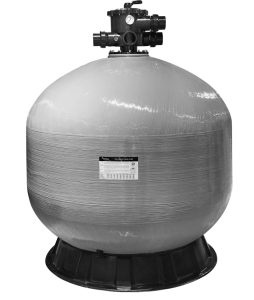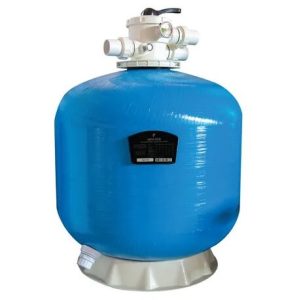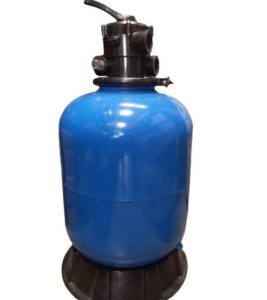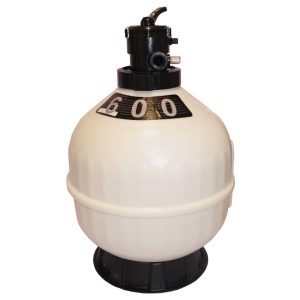


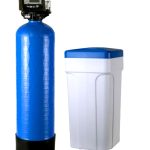
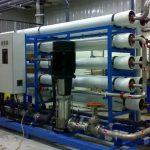
A sand filter (filter document) is a device for water purification that is made of a tank (containing sand or pure sand) made of steel, concrete or fiberglass or a polyethylene FRP tank that is made in the form of a cylinder or cube and physically removes solid and suspended particles. Mud and biological suspended particles are up to 50 microns.
Sand filter is considered as the most widely used equipment in the filtration of suspended solids in water. Sand filters can easily capture suspended particles in water up to 50 microns, or in simpler words, reduce water turbidity and, as a result, bring water clarification.
They use a sand filter to remove physical biological suspended particles in water and filter water up to 50 microns in diameter. Impurities in water include organic matter, bacteria, mud, color, and plankton. Purified water is slowly poured into the sand filter tank and the dirt particles in the water are captured by the sand (silica) and the purified water is directed to the consumer through the filter holes. This filter technology is particularly suitable for pre-treatment of disinfection equipment, recirculating systems, wash water processes, irrigation systems, pond water treatment, pool water treatment and groundwater cleaning.
Sand filter is part of the initial stages of water purification, and after that, carbon filtration is used in the next stages. Sand filters are made horizontally and vertically. The diameter of the vertical filter is from 0.5 to 3 meters and its height is from 0.5 to 2.5 meters. In the following, several types of sand filters are explained.
The effluent from the primary septic tank (Imhof tank) can be introduced into a filter. The environmental conditions of this filter are such that biological factors grow on its fixed surfaces and consume the organic load of the wastewater which is in solution and reduce the pollution of the wastewater. The more biological growth on these surfaces, the better the efficiency of wastewater treatment. For this reason, P.V.C. media and granulated sand are used in it, which have more surfaces and less volume.
Due to the fact that the treated wastewater is discharged through this porous environment and the suspended materials and parasite eggs in the wastewater are trapped in these layers and the parasite egg-free wastewater is discharged into the environment.
On the other hand, by using UP FLOW in such filters, gravity is also used to settle colloidal and other substances as much as possible. The chemical reaction removes much of the odor from the sewage.
Types of sand filters:
According to the type of material and performance, the sand filter is:
- Resin sand filter
- Galvanized sand filter
- Vertical sand filter
- Horizontal sand filter
- Standing sand filter
- Aquarium sand filter
- Boiler sand filter
- Jacuzzi sand filter